
Why AI-Driven Structured Micro-Learning Is Displacing the Traditional Classroom
Classover Holdings, Inc. (Nasdaq: KIDZ) | February 2026
Executive Perspective
The K-12 education system was designed for an industrial era of mass production, not an information era of mass personalization. Its core delivery model—the one-to-many, teacher-led classroom—is now its fatal flaw. This legacy architecture is collapsing under the dual pressures of a global teacher shortage and its inability to provide the personalized learning required by a modern, AI-native world [1].
For decades, the industry has attempted to solve this with incremental fixes: digitizing content, adding administrative tools, or building better communication platforms. These efforts have failed to change the fundamental outcome because they do not address the core delivery problem. The system remains structurally constrained by human bandwidth.
This white paper argues that a systemic disruption is underway, driven by a new delivery model: AI-Driven Structured Micro-Learning. This is not an incremental update to the classroom; it is its replacement. By deconstructing monolithic lessons into an intelligently orchestrated system, this model breaks the dependency on linear headcount growth and delivers personalization at a scale previously unimaginable.
This paper explains this disruption in three parts:
● Part 1 — The Scale Problem: Why the traditional classroom model is architecturally incapable of scaling.
● Part 2 — The Orchestration Dividend: How AI-driven coordination unlocks value that manual instruction cannot.
● Part 3 — The System Advantage: Why this new model creates compounding performance gains that legacy systems cannot replicate.
PART 1: THE SCALE PROBLEM
Why the Classroom Model Cannot Be Fixed by Hiring More Teachers
The traditional education model operates on a simple, linear equation: more students require more teachers. This makes the entire system’s capacity directly dependent on the available supply of human educators. In an era of declining teacher enrollment and a projected global shortfall of 44 million teachers by 2030, this model is mathematically unsustainable [1]

Figure 1: The Legacy Model Is Unsustainable — Global Teacher Shortfall Projection
The persistence of the one-to-many classroom model is not an execution failure. It is the predictable outcome of a system that lacks the architectural capacity to absorb variability in student needs and teacher supply.
This architectural flaw manifests in three critical ways, as illustrated below.
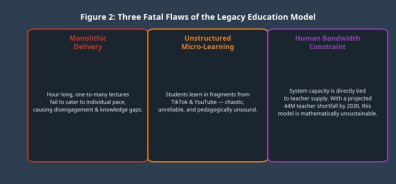
Figure 2: Three Fatal Flaws of the Legacy Education Model
This leads to a first-order conclusion: Efficiency cannot emerge from a system that is structurally designed for linear, one-to-one scaling. To solve the delivery problem, the architecture itself must be replaced.
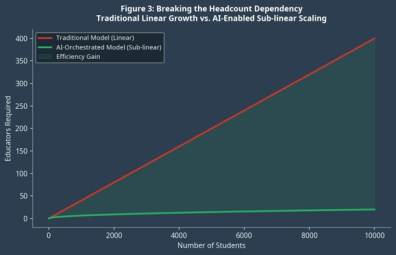
Figure 3: Breaking the Headcount Dependency
PART 2: THE ORCHESTRATION DIVIDEND
Why AI-Driven Coordination Unlocks Value That Manual Instruction Cannot
Once we recognize that the constraint is architectural, the primary problem shifts from a lack of resources (teachers) to a lack of intelligent coordination. The traditional classroom is an information silo where the teacher is the sole orchestrator, a task that becomes impossible to perform effectively at any real scale.
This is where AI-Driven Structured Micro-Learning provides the dividend. We define this model by two core components:
● Structured Micro-Learning: We deconstruct complex subjects into their fundamental, pedagogically-sound components. These are not just short videos; they are interactive, measurable learning modules designed to be part of a comprehensive knowledge graph.
● AI Orchestration: An AI Tutor acts as the system’s execution layer. It dynamically assembles these modules into a personalized, adaptive learning path for each student, delivered at the precise moment of need. It continuously assesses, adapts, and allocates instructional resources based on real-time performance data.
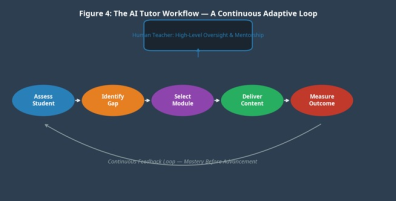
Figure 4: The AI Tutor Workflow — A Continuous Adaptive Loop
This is the critical difference: we are not just offering fragmented content; we are providing structure and personalization at scale through an intelligent orchestration engine.
This model directly addresses the “2 Sigma Problem” identified by educational researcher Benjamin Bloom, which found that one-to-one tutoring yields results two standard deviations higher than conventional group instruction [2]. AI orchestration makes it possible to deliver the benefits of one-to-one tutoring at the scale of a one-to-many system.
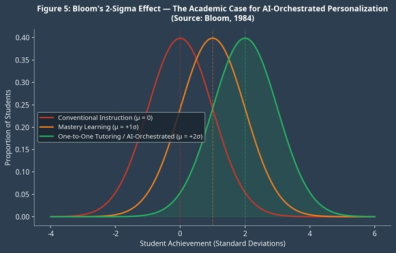
Figure 5: Bloom’s 2-Sigma Effect
PART 3: THE SYSTEM ADVANTAGE
Why This New Model Creates Compounding Performance Gains
The final, and most disruptive, element of this new model is the system advantage. Unlike the traditional model where quality can degrade with scale, an AI-orchestrated system becomes more intelligent and more efficient as it grows.
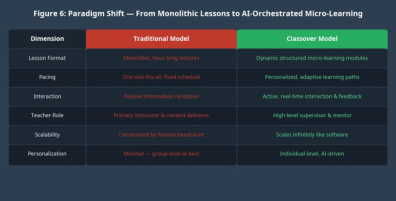
Figure 6: Paradigm Shift — From Monolithic Lessons to AI-Orchestrated Micro-Learning
Throughput as Proof of Disruption
A clear indicator of this advantage is instructional throughput per educator. In a manual model, an educator’s capacity is finite. In our AI-driven model, the system absorbs the cognitive load of personalization, allowing the educator to transition to a high-level supervisory role.
Research demonstrates that AI tutoring systems can autonomously resolve over 90% of student queries without faculty intervention [3], while AI-assisted preparation reduces teacher planning time by 31% [4] and overall teacher workload by up to 40% [5]. When these effects converge in a single orchestrated system, the educator’s role shifts fundamentally — from primary instruction and response to high-level supervision. This structural shift enables a single educator to effectively oversee a substantially larger student cohort, representing a potential increase of up to 200% in per-educator instructional capacity.
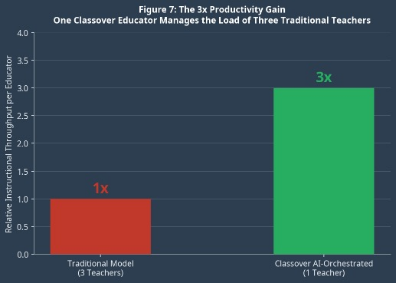
Figure 7: The Productivity Multiplier Effect
This is not an incremental improvement; it is a fundamental change in the economic reality of instructional delivery.
The Compounding Effect
When an intelligent execution layer supports AI-orchestrated learning at scale, the benefits compound across all critical dimensions.
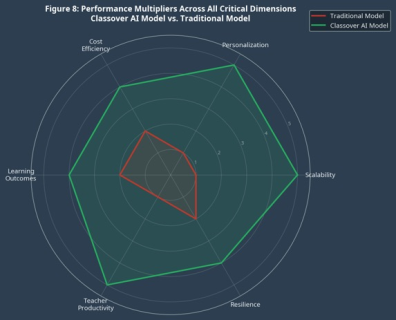
Figure 8: Performance Multipliers Across All Critical Dimensions
● The system becomes more intelligent as it gathers more data, refining its instructional strategies.
● The economic model inverts: costs no longer scale linearly with enrollment, creating a virtuous cycle of improvement and margin expansion.
● The role of the educator is elevated from a delivery mechanism to a high-value mentor and learning architect.
Conclusion: The Disruption is Here
The era of the monolithic classroom as the sole delivery model for education is over. Its structural limitations are no longer acceptable in a world that demands personalization, scalability, and efficiency. Incremental improvements will not suffice.
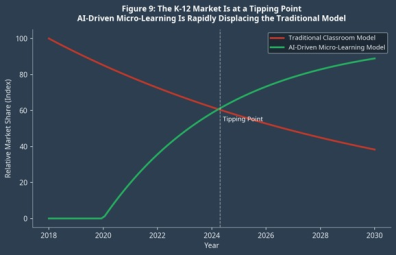
Figure 9: The K-12 Market Is at a Tipping Point
AI-Driven Structured Micro-Learning is the new paradigm. Classover is not waiting for the future of education; we are building its delivery engine. By shifting the instructional load from manual human effort to an intelligent, automated system, we are unlocking a new level of productivity, personalization, and resilience for the entire education ecosystem. This is more than an innovation; it is a fundamental disruption of the instructional delivery model. And it has already begun.
References
[1] UNESCO. (2023, October 5). Global Report on Teachers: Addressing teacher shortages. https://www.unesco.org/en/articles/global-report-teachers-what-you-need-know
[2] Bloom, B. S. (1984). The 2 Sigma Problem: The Search for Methods of Group Instruction as Effective as One-to-One Tutoring. Educational Researcher, 13(6), 4–16.
[3] Harrington, J. (2025). Enhancing Online Learning: The Impact of AI Tutors on Student Support and Faculty Workload. Journal of Health Administration Education, 41(2), 305-317.
[4] Education Endowment Foundation. (2024, December 12). Teachers using ChatGPT – alongside a guide to support them to use it effectively – can cut lesson planning time by over 30 per cent. https://educationendowmentfoundation.org.uk/news/teachers-using-chatgpt-alongside-a-guide-to-support-them-to-use-it-effectively-can-cut-lesson-planning-time-by-over-30-per-cent
[5] McKinsey & Company. (2020, January 27). How artificial intelligence will impact K-12 teachers. https://www.mckinsey.com/industries/education/our-insights/how-artificial-intelligence-will-impact-k-12-teachers